Notes on Southeast Asian Affairs, July 1 2026
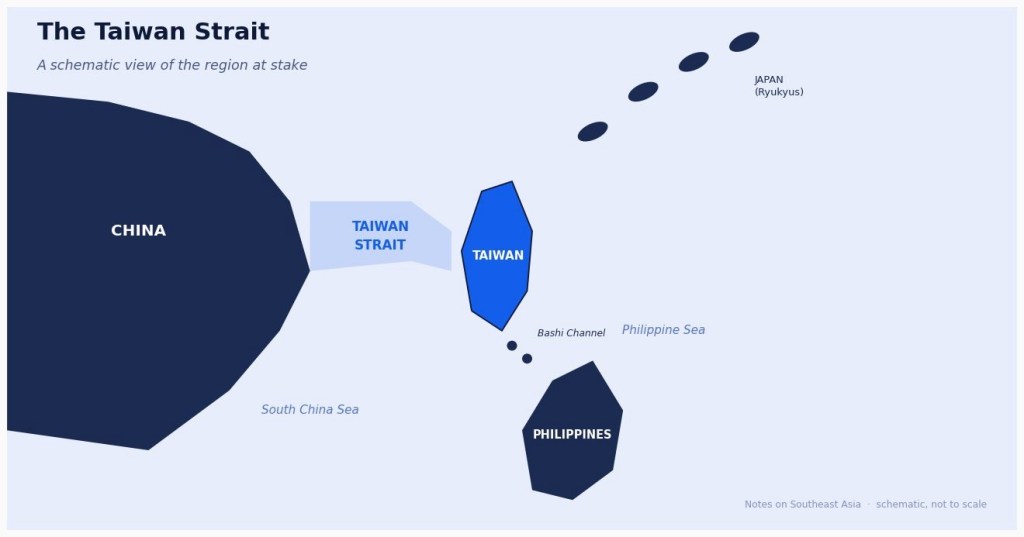
Every time tensions rise across the Taiwan Strait, the commentary that follows runs through two capitals: Washington and Beijing. Taipei gets a mention; Southeast Asia rarely does. But a Taiwan crisis would not stay contained to the strait. It would move through the same shipping lanes, the same semiconductor supply chains, and the same ASEAN meeting rooms this blog exists to watch.
That is the vantage point of what follows: a close, sustained observer of this region, writing from a life divided between the United States and the Philippines, who thinks Southeast Asia’s stake in this question deserves more than a footnote. So it is worth asking what a revived version of the 1972 Shanghai Communiqué, call it Shanghai Communiqué II, would need to look like if it took that stake seriously.
What the Original Communiqué Actually Did
The 1972 communiqué is remembered as a diplomatic breakthrough, but its real genius was narrower than that. It created a formula ambiguous enough that nobody had to lose. Washington could avoid endorsing Beijing’s sovereignty claim over Taiwan without repudiating it either; that single sentence of studied vagueness bought decades of stability, not because it resolved anything, but because it postponed resolution in a way both sides could live with.
For fifty years, that postponement was enough. It underwrote diplomatic normalization, economic integration, and, from this side of the Pacific, a workable regional order that let ASEAN states trade, grow, and largely stay out of the crossfire.
Why the Old Formula Is Wearing Thin
That order rested on assumptions that no longer hold. China’s economic and military weight in the region is no longer abstract; it shows up in infrastructure financing, maritime disputes, and diplomatic leverage that our governments navigate constantly. Taiwan, meanwhile, has consolidated a democratic identity distinct enough that the old logic, that time alone would make unification easier, now looks naive. And the US-China rivalry has hardened into something structural, contested across semiconductors, AI, alliances, and the rules of regional order itself, rather than a manageable disagreement over one island.
But the deeper problem is not any single flashpoint. It is a widening trust deficit. Beijing fears permanent separation; Washington fears coercive reunification; Taiwan fears absorption; the region fears a war it did not choose and cannot afford.
What’s Actually at Stake for Us
Set the sovereignty question aside for a moment and look only at exposure. A serious Taiwan Strait crisis would hit the sea lanes connecting Northeast and Southeast Asia, rattle the semiconductor supply chains regional manufacturing depends on, spike shipping and insurance costs, and force ASEAN states toward alignments most have spent decades avoiding.
That last point may be the most corrosive. The real nightmare is not only war itself; it is losing room to maneuver before war even starts, as polarization forces governments into choices they never wanted to make.
Toward an ASEAN-Facing Framework
If a Shanghai Communiqué II is going to mean anything for this region, it must do more than restate ambiguity. What would it need instead?
Long-horizon management, not forced settlement. The most valuable thing the original formula did was reject urgency. A revised version should do the same: no unilateral force, no unilateral status-quo changes, no coercive timetable, no escalation staged for domestic political theater on any side.
Dignity for everyone at the table. Beijing wants civilizational respect and no narrative of humiliation; Taiwan wants its democratic choices honored, not erased; Washington wants credibility; ASEAN wants autonomy and a seat that is not merely decorative. A framework that requires theatrical defeat for any of these parties will not hold. Southeast Asian diplomacy has long understood that de-escalation works better than triumphalism.
Practical resilience over abstract sovereignty debates. Rather than centering everything on the unresolved political question, a workable framework should build shared material interests: shipping and port resilience, supply-chain continuity, fisheries governance, disaster response, cyber resilience. None of this settles anything philosophically. But it raises the cost of conflict for everyone and gives the region something concrete to build together.
Real crisis-management plumbing. Military hotlines; air and maritime deconfliction procedures; cyber incident norms; emergency shipping coordination. None of this solves the underlying dispute. It only reduces the odds that an accident becomes a war.
A table, not a gallery. Indonesia as a convening power, Singapore as a financial and strategic intermediary, the Philippines and Vietnam given their direct exposure, Japan and India as major stakeholders: ASEAN need not own the Taiwan question. But it should not be reduced to watching from the sidelines either.
The Honest Obstacles
At its best, this kind of framework-building could give the region real agency in a crisis not of its making. At its worst, it collapses under the very pressures it is meant to manage. Beijing is wary of any multilateralization of Taiwan; Washington tends to default to deterrence language rather than regional diplomacy; Taiwan is understandably suspicious of any formula that obscures democratic consent. And within ASEAN, member states read the China threat very differently, since some prioritize economic ties while others fear that visible engagement on Taiwan will be read as interference.
These constraints are real. They do not make the project pointless; they mean the work has to happen quietly, incrementally, and mostly out of the headlines.
In Conclusion
The original Shanghai Communiqué did not solve the Taiwan question. It bought time by converting hostility into managed competition, and for decades that was enough. It no longer is. The task now is not sovereign resolution; nobody credible expects that. The task is preventing a Taiwan crisis from shattering the wider regional order Southeast Asia has spent two generations building.
A credible Shanghai Communiqué II would need to:
- protect regional continuity in trade and shipping
- slow escalation through real crisis-management channels
- preserve diplomatic space for long-horizon coexistence
- give Southeast Asia more than a front-row seat to someone else’s crisis
That is a modest ambition compared to resolving the Taiwan question outright. It may also be the only realistic one.


Leave a Reply